Greenheart vs. Treated Softwood: A Whole-Life Cost Comparison for Marine Structures
Target audience: Procurement managers, resort developers, civil engineers
The unit cost comparison is straightforward: Greenheart costs more per cubic metre than CCA-treated softwood. That is the beginning and end of the conversation for most procurement decisions, and it is why so many marine structures are rebuilt on a 10–15-year cycle.
This article sets out the full cost picture. For any marine or waterfront structure expected to remain in service for 20 years or more, the procurement decision looks very different when you account for the complete lifecycle.
The Treated Softwood Assumption
CCA-treated softwood (typically pine or similar species) is the default specification for marine piling, fender systems, and jetty decking across the Caribbean and US Eastern Seaboard. It is familiar, widely available, and priced into most standard bills of quantities. For straightforward above-ground structures in temperate climates, it performs adequately.
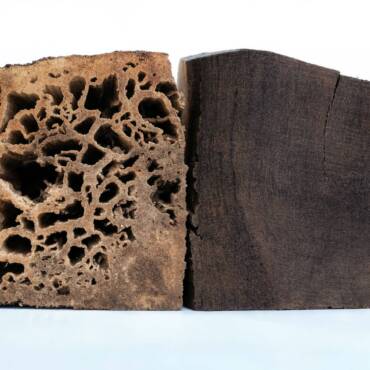
In tropical and subtropical marine environments, the picture changes. CCA treatment protects the outer zone of the timber, but treatment penetration is not uniform throughout the section, and it degrades over time. Once the timber begins to check (surface cracking caused by UV exposure and moisture cycling) or sustains any mechanical damage below the waterline, marine borers gain access to the untreated interior. Teredo navalis and Limnoria species, both present throughout Caribbean and US coastal waters, can hollow out an apparently sound pile within three to five years of colonisation beginning.
The result is a structure that looks intact from the surface and is structurally compromised from within.
Typical Replacement Cycles
Based on industry experience in tropical marine environments, treated softwood substructure in direct saltwater contact typically requires:
- Inspection at year 5–7
- Partial replacement at year 8–12, depending on borer exposure
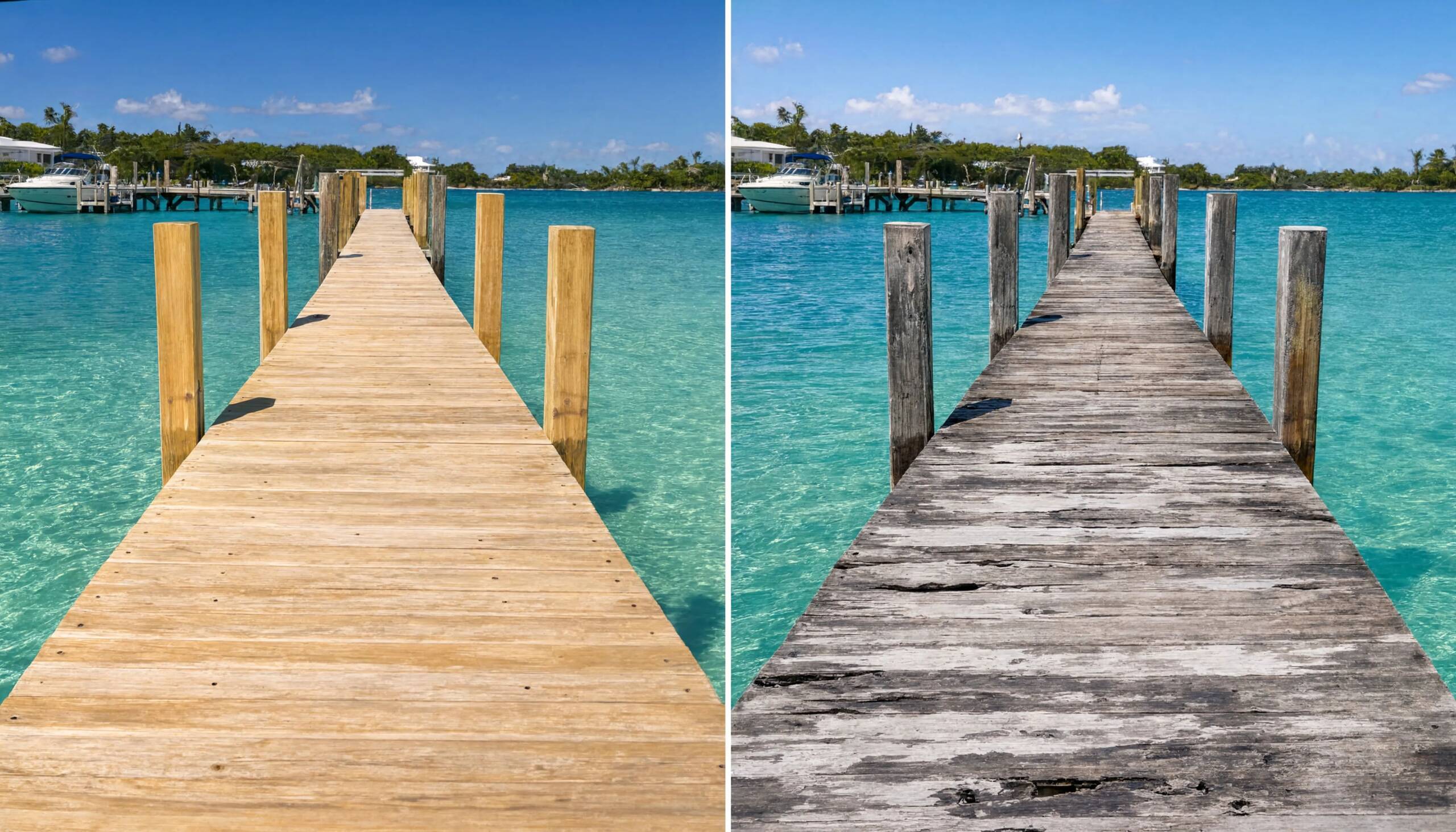
- Full substructure replacement at year 12–18
For a marina or resort jetty, that replacement is not simply a materials cost. It includes access scaffolding or marine equipment, contractor mobilisation (often to a remote island location), temporary closure of the facility, and, in a hospitality context, revenue loss and reputational impact during the works programme.
A conservative estimate for a replacement project on a mid-sized resort jetty, including access, contractor costs, and downtime, runs to three to five times the original build cost.
How Greenheart Works Differently
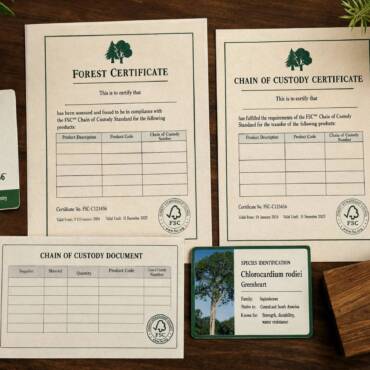
Chlorocardium rodiei — Demerara Greenheart — operates on a fundamentally different principle. With a natural density of approximately 1,000 kg/m³, the timber is physically impenetrable to Teredo and Limnoria. No treatment is required, and no treatment degrades. The borer resistance is intrinsic to the material, not applied to it.
Greenheart lock gates and harbour fender systems installed in the 1950s and 1960s remain in active service across the Caribbean today. Port engineers who have specified it once rarely return to softwood for primary marine structure.
Running the Numbers
For a representative project, a 30-metre resort jetty with 12 piles, timber decking, and a fender system, the cost comparison over a 30-year asset life looks approximately as follows:
Treated softwood: Lower initial material cost, but two full replacement cycles over 30 years, each carrying full access and contractor costs. The total whole-life cost over 30 years is substantially higher than the initial procurement figure suggests.
Greenheart: Higher initial material cost, no replacement cycle required within the design life, minimal maintenance regime. The total whole-life cost is significantly lower than that of treated softwood when replacement cycles are modelled.
The crossover point where Greenheart’s total lifecycle cost falls below treated softwood typically occurs somewhere between years 12 and 18, depending on borer exposure, access difficulty, and local contractor rates.
The Procurement Question
The right question is not ‘what does the timber cost?’ It is ‘what does the structure cost over its design life?’
For any marine or waterfront structure expected to be in service beyond 15 years, jetties, fender systems, dock substructure, boardwalks, pontoon moorings, a lifecycle cost comparison should be part of the specification process, not an afterthought.
Golden Arrow Timber can provide lifecycle cost modelling for specific projects on request. If you are in the design or early procurement phase on a marine structure, contact us before the spec is finalised: info@goldenarrowtimber.com | 020 3411 4150
Golden Arrow Timber Ltd | info@goldenarrowtimber.com | 020 3411 4150 | goldenarrowtimber.com
20 Wenlock Road, London, N1 7GU, England