The Lacey Act and Tropical Hardwood: What Caribbean Contractors and Developers Need to Know
Target audience: Contractors and developers on US-connected Caribbean projects
If your project involves a US-owned client, US-registered contractor, US-sourced financing, or timber that will ultimately be imported into the United States, your tropical hardwood supply chain needs to be fully documented before timber goes in the ground.
The Lacey Act is the relevant US legislation, and non-compliance carries serious commercial consequences.
What the Lacey Act Requires
The Lacey Act (as amended in 2008) prohibits the import, export, transport, sale, or purchase of plants — including timber and timber products taken in violation of US or foreign law. For importers of tropical hardwood into the United States, it requires a declaration at the point of import is required specifying:
- The scientific name of the species (genus and species)
- The value of the importation
- The quantity of the plant
- The country where the plant was harvested
The declaration must be accurate. Submitting false or incomplete information, whether intentionally or through inadequate supplier documentation, constitutes a federal offence.
Why This Matters for Caribbean Projects
The compliance requirement extends beyond direct imports into the US. If you are a Caribbean-based contractor supplying to a US-owned resort group, building infrastructure that feeds into a US-regulated supply chain, or working with a US-registered joint venture partner, your material provenance documentation may be scrutinised as part of project compliance requirements.
US-based developers and project owners increasingly include timber compliance documentation as a contractual requirement, particularly on higher-value resort, marina, and infrastructure projects. Suppliers who cannot produce it create a procurement risk for the buyer.
This is not a theoretical concern. Enforcement actions under the Lacey Act have targeted importers, manufacturers, and retailers, and the reputational and financial consequences of a compliance failure on a major project are substantial.
What Compliant Documentation Looks Like
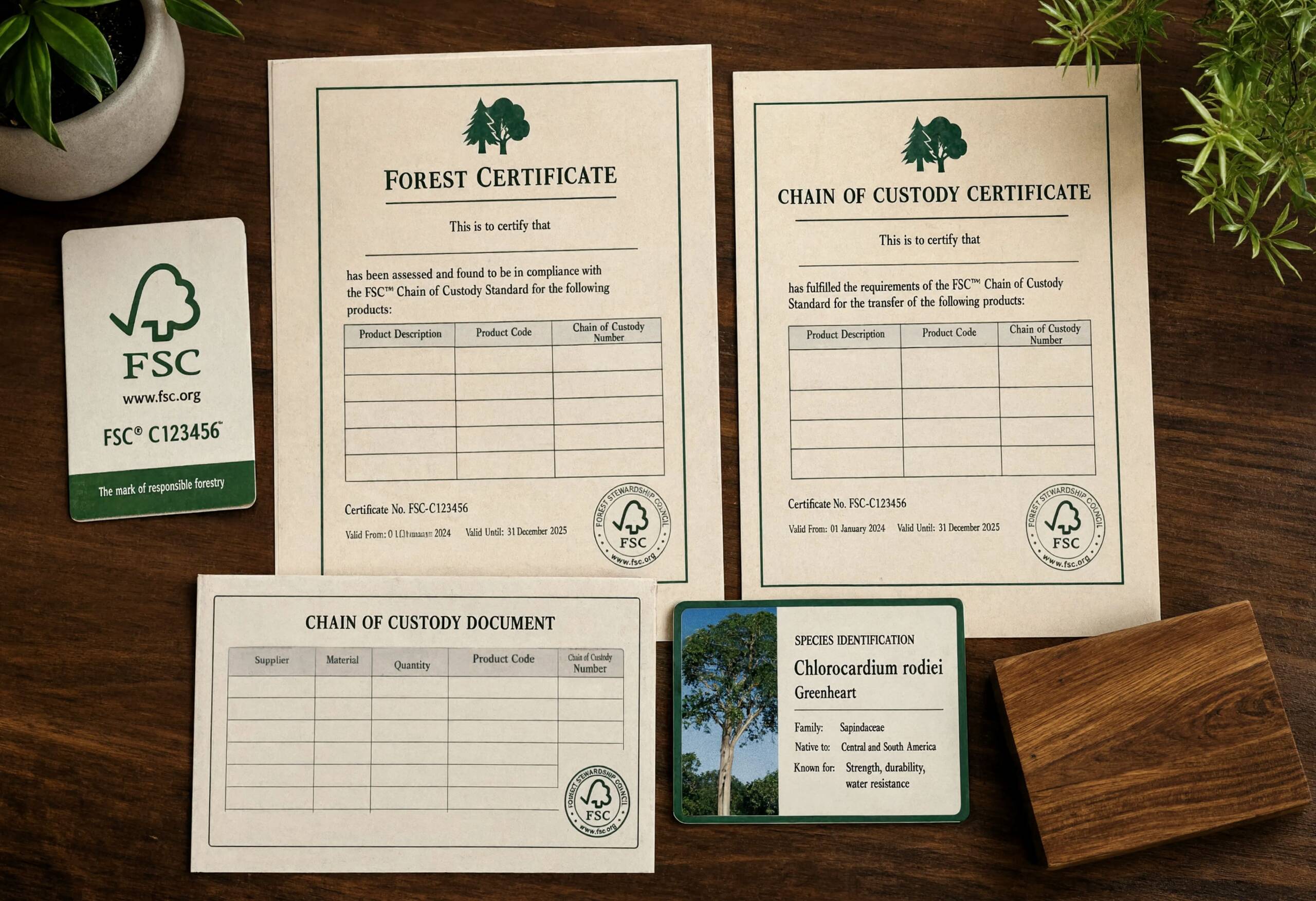
For Greenheart sourced from Guyana, a complete documentation package includes:
- Species confirmation: Chlorocardium rodiei (scientific name required for Lacey Act declarations)
- Country of harvest: Guyana
- Licensed forestry operator records: confirmation that the timber originates from a Guyana Forestry Commission licensed operation
- Chain of custody documentation: from forest to point of export
Golden Arrow Timber supplies full documentation with every shipment as standard. If you are buying tropical hardwood from a supplier who has not raised the documentation conversation, ask directly — and if they cannot provide it, that is a compliance risk you are absorbing.
EUDR: The Incoming UK and EU Parallel
For UK and European buyers, the EU Deforestation Regulation (EUDR) and its expected UK equivalent introduce similar due diligence requirements for tropical timber. Operators placing timber on the EU or UK market will need to demonstrate that products do not originate from recently deforested land, with geolocation and supply chain traceability requirements.
The compliance landscape for tropical hardwood is tightening on both sides of the Atlantic. Suppliers with documented, licensed supply chains from regulated forestry operations, as is the case with Guyana’s GFC-licensed Greenheart operations, are in a stronger position than those relying on undocumented or informal sources.
If you have a project where timber compliance documentation is a requirement, contact us to discuss what we can provide: info@goldenarrowtimber.com | 020 3411 4150
Golden Arrow Timber Ltd | info@goldenarrowtimber.com | 020 3411 4150 | goldenarrowtimber.com
20 Wenlock Road, London, N1 7GU, England